Solar Rotation Effects part 2 - The Gauquelin data
Abstract
Some of the Gauquelin professional effects are considered in relation to the 27.3-day cycle mapped by the Moon in the zodiac, which may also be a solar-rotational period.
Evidence is found that the Gauquelin Effect in some professional groups are correlated with this cycle. The SA-UR cycle is also proposed as a convenient way of assessing possible effects of the 11.2-yr Schwabe (Sunspot) Cycle, which allows simple calculation and distinguishes the four Schwabe Cycles within each SA-UR, instead of assuming that they are all alike. Births of eminent professionals are shown to have different distributions across the SA-UR cycle depending on whether a Gauquelin planet is placed in the Key Sectors or in the minor Plus-zones. The place of social effects in relation to the Gauquelin data is discussed.
Excel graphs cannot be uploaded here, so I am in the process of converting them to PNG format. The whole article can be found on my page on Researchgate.net and the DOI is 10.13140/RG.2.2.21745.24164
Introduction
Part 1 (Douglas 2025) set out from Michel Gauquelin’s study of possible zodiacal effects among his various groups of eminent professionals (M. Gauquelin 1978) in which he noted two curious results but dismissed them as anomalies, since they only occurred for one body (The Moon) and only involved the distribution of the births in two professions, writers (N = 1352) and scientists (N = 1094). In both cases the patterns were dominated by a pair of peaks in opposite positions in the zodiac cycle, in Gemini and Sagittarius for writers and overlapping these signs and the neighbouring decanates of Scorpio and Taurus among scientists.
The very significant deviations from the means as well as the consistent structuring into opposing pairs of peaks strongly suggested something other than random variations, and the first part of this report was an attempt to gather more data.
A further surprising result followed: when the same data was plotted against the 29.5-day Lunation cycle – for which more evidence of possible lunar effects exists - the result was an amorphous splatter.
At around the same time however I had been reading several reports of solar activity at birth influencing the length of subsequent lifespans, and it also occurred to me that 27.3 days is very close to the period of rotation of the sun on its axis – could there be a solar connection as well as, or masked by, the apparent Lunar zodiacal one?
The first part of this report (Douglas 2025) therefore consisted in attempts to do two things. First to find ways of distinguishing between possible solar and lunar influences, taking advantage of the many unique complexities of the lunar orbit, and second to look for possible connections to longevity in datasets where dates of death were available.
Attempts to distinguish solar from lunar were not conclusive, some lunar parameters produced correlations others not, while two other Gauquelin datasets showed pairs of opposing peaks as well as others at 90 0 separations (Gauquelin New Murderers (N = 622) and Liberation Fighters (N=616)). This result for murderers is noteworthy because they showed no sign of a Mars Effect, as Michel Gauquelin noted (Gauquelin 1984), suggesting that the Moon in Zodiac effect is separate from the Gauquelin Effect.
To follow the second pathway, three sets of data were available with dates of death (Mathematicians, Muller’s German aristocrats and Gauquelin data on ordinary people collected in Paris hospitals), which all showed pairs of opposing peaks in their lunar zodiac distributions for certain ranges of lifespan. So, whatever the source of these variations there is clear evidence of replication of structured variations of birth dates with the 27.3-day cycle.
At this stage there are thus three paths to pursue –
1. to investigate whether the Gauquelin Effect is correlated with the lunar zodiac cycle,
2. to look for possible signs of other solar activity patterns, such as the Sunspot Cycle,
3. to collect lifespan data for the Gauquelin eminent professionals and use them for the two investigations just listed.
The present report
The first two paths are followed some distance now, and a new method for rapidly assessing possible influence of the Sunspot (Schwabe) Cycle and other longer cycles in astro-research data is described.
Collecting dates of death for the third pathway is a time-consuming task even with online databases and up to 25% of the necessary data is not available, nevertheless four Gauquelin professions have been studied so far with promising results, and will be reported separately: Writers, Scientists, Actors, Politicians. The data on Scientists was supplemented with the published list of Nobel Prize winners in Physics and Chemistry after excluding the very small number of people who are also present among the Gauquelin Scientists. The Nobel data only has missing dates of death for those who are still alive.
In the context of astrological research, it is important to investigate whether the 27-day cycle effects proposed in Part 1 are involved in the well-known Gauquelin Planetary effects for eminent professionals. The data below show that the answer depends on the profession.
The Gauquelin Effect and the Moon in the zodiac
In evaluating the possibility that the Gauquelin Effect in general might be correlated with a 27.3 - day cycle, an obvious starting point is the strong peaks in the lunar zodiacal cycle for Writers and Scientists, which were the spur to begin this investigation. Accordingly, I extracted the births in these peak regions of the lunar zodiac graph and plotted their variation across Gauquelin sectors for each of the four Gauquelin planets JU, VE, MA, and SA for Writers. The result was clear – completely insignificant variations, which leaves us with a puzzle. Nevertheless 27.3-day modulations of Gauquelin Effects innother professions were found, which I will now describe.
We can now consider two cases with exceptionally clear results. In the case of Actors and Politicians, (considered together because both show clear excesses of Jupiter in the Key Sectors (36-3 and 9-12)), there is a statistically significant increase in the Gauquelin Effect when the total data (N = 2410) are filtered by extracting only the births with peaks in the Moon’s zodiac position, see Fig.1
Figure 1. On the left the distribution of JU in Gauquelin sectors is shown as a % deviation from the mean for actors and politicians combined (N = 2410), while on the right this same data has been selected for those births which happened when the MO was in three decanate ranges that form a T-Square: PI3-AR3; CN3; SG3-CP1, 7 sectors of 100 width. Note the much larger amplitude of the deviations on the right.
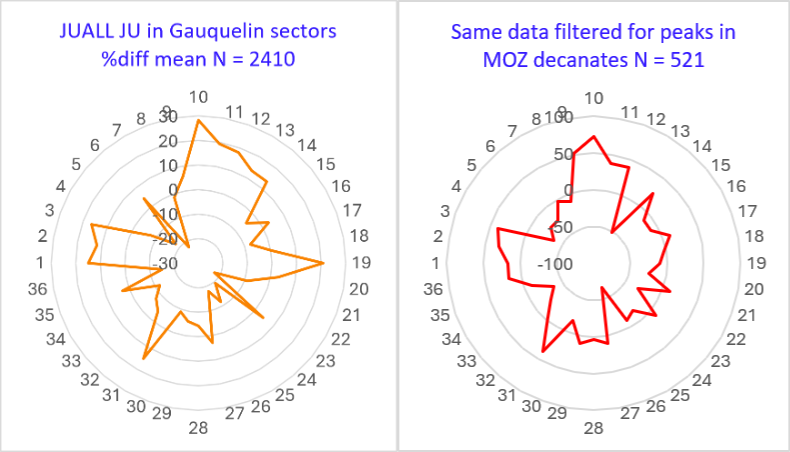
To assess these results statistically a Contingency Chi-Squared test was used, but it is important to examine the G-sector peak positions first. In the selected sample N = 521 there are clear peaks in sectors 36- 3 and 9-12, whereas the whole set N = 2410 has peaks in sectors 1-3 and 9-14, while sector 36 has a lower-than-average frequency of births. The classical Gauquelin peaks are in sectors 36-3 and 9-12. The expected number of births with MO in 7 sectors is 7*2410/36 = 468.1, so the observed N = 521 is an excess of +52.9.
G+ G - Total
MO zodiac + 160 361 521
MO Zodiac - 443 1446 1889
Total 603 1807 2410
The expected value for the total of 521 births with MO in peak decanates (PI3 – AR3; CN3; SG3 – CP1) is 603*521/2410 = 130.34, thus the excess is 160-130.34 = 29.66. And the Chi-Squared Contingency value (dF = 1) is (29.66)2* (1/ 13.34 + 1/ 372.66 + 1/390.66 + 1/1516.34) = 11.94. From this we find that p = 0.0005, highly significant. The fact that the filtering by selecting MO Zodiac peak decanates restores the peaks to classical Gauquelin key sectors is worth noting.
For Painters and Musicians, amalgamated (N = 2720), the Gauquelin Effect for VE is barely significant (Chi-SQ = 4.6, dF =1) but when the data are filtered for a set of Moon Zodiac distribution peaks, it emerges very strongly (Chi-SQ = 14.8), as shown in Fig 2b. The Moon zodiac phases that reveal this correlation are different from those for Writers and Scientists, but they form a T-Square in the zodiac.
Figures 2a & 2b
Showing the distribution of % deviations from expectation of VE in 36 Gauquelin sectors for combined painters and musicians (File VEALL, N = 2720) on left, and after selecting for births with MO in the following zodiac decanates: AR1, GE2-CN1, VI3-LI1 (N=466). Note the much larger % deviations in the filtered set as well as the shift to the classic key sectors, 36-2 and 9-12. Note the similar ranges of MO decanates to those in Figure 1.
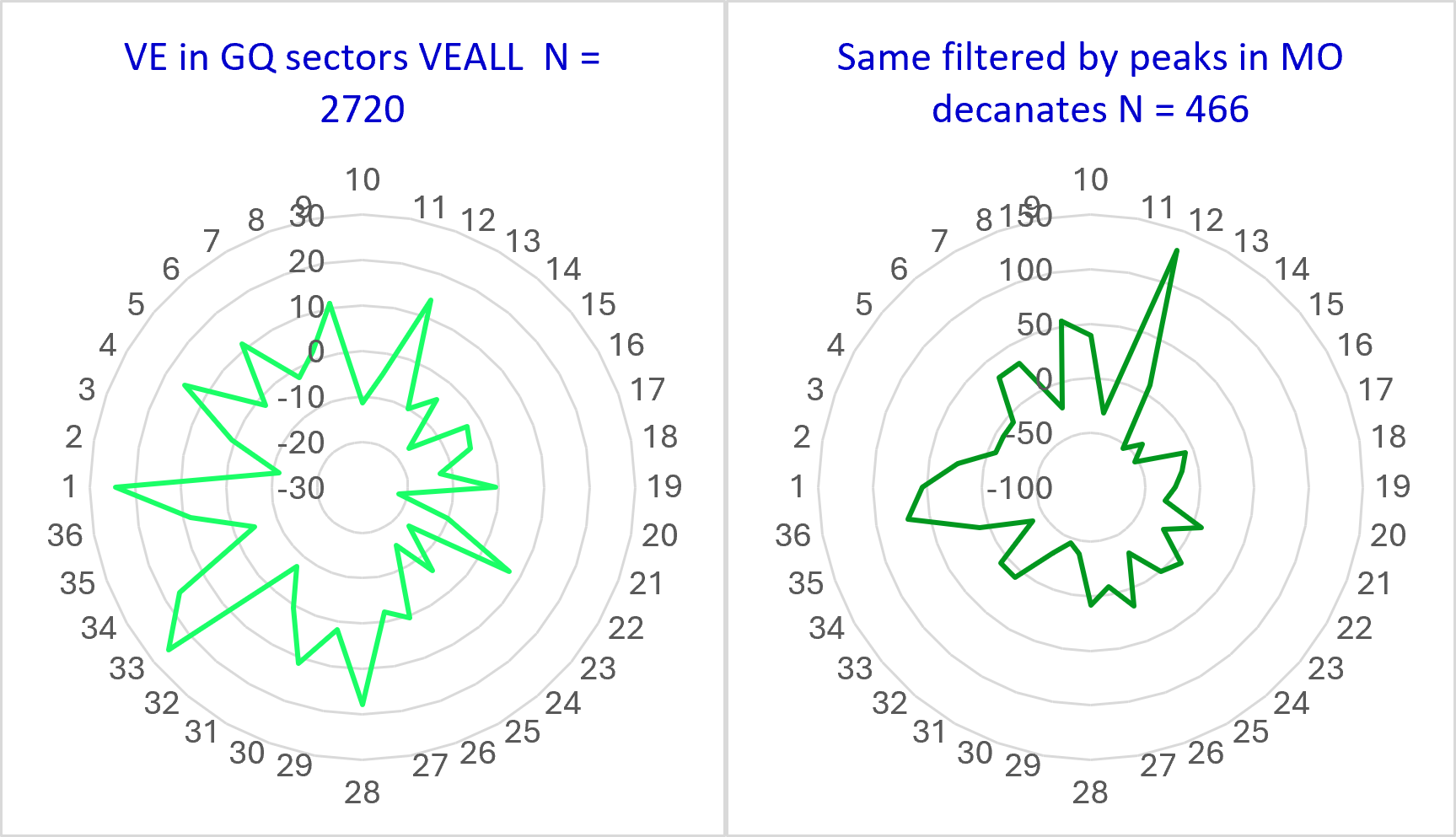
In the whole VEALL set (N=2,720) the Gauquelin key sectors listed above contain 590 births, so by proportion the set of 466 are expected to hold 101.08, but the actual figure is 135, an increase of 33.92, leading to a Chi-SQ value of 14.53 (df = 1), and a Cohen’s Effect Size w of 0.177. This Effect Size is classed as low by Cohen, but it is also important to consider the number of births in the whole VEALL set compared with what is expected with no Gauquelin Effect.
Using the total Professional data as a comparison (N=15,934) in which there are 3,313 births with VE in these sectors, the predicted figure for a sample of N = 2720 is 565.5, compared to the actual figure of 590, which is an excess of +34.5 births, almost identical to the surplus in the filtered VEALL data of 33.92 calculated above. The expected frequency of births with VE in sectors 36-2 and 9-12 in a set of 466, using the total professional data as a standard is 96.9, so the actual number of 135 is raised by 38.1. We can therefore say that the surplus that is associated only with births also having Moon in these decanates is more than enough to account for the whole observed surplus in these two professions, Painters and Musicians.
A more challenging conclusion to draw would be that the Gauquelin Effect itself cannot be defined simply as an excess of VE in key sectors: the MO Zodiac – or solar rotation effect - is an integral part of it. This does not mean that the same is true for all Gauquelin Planets.
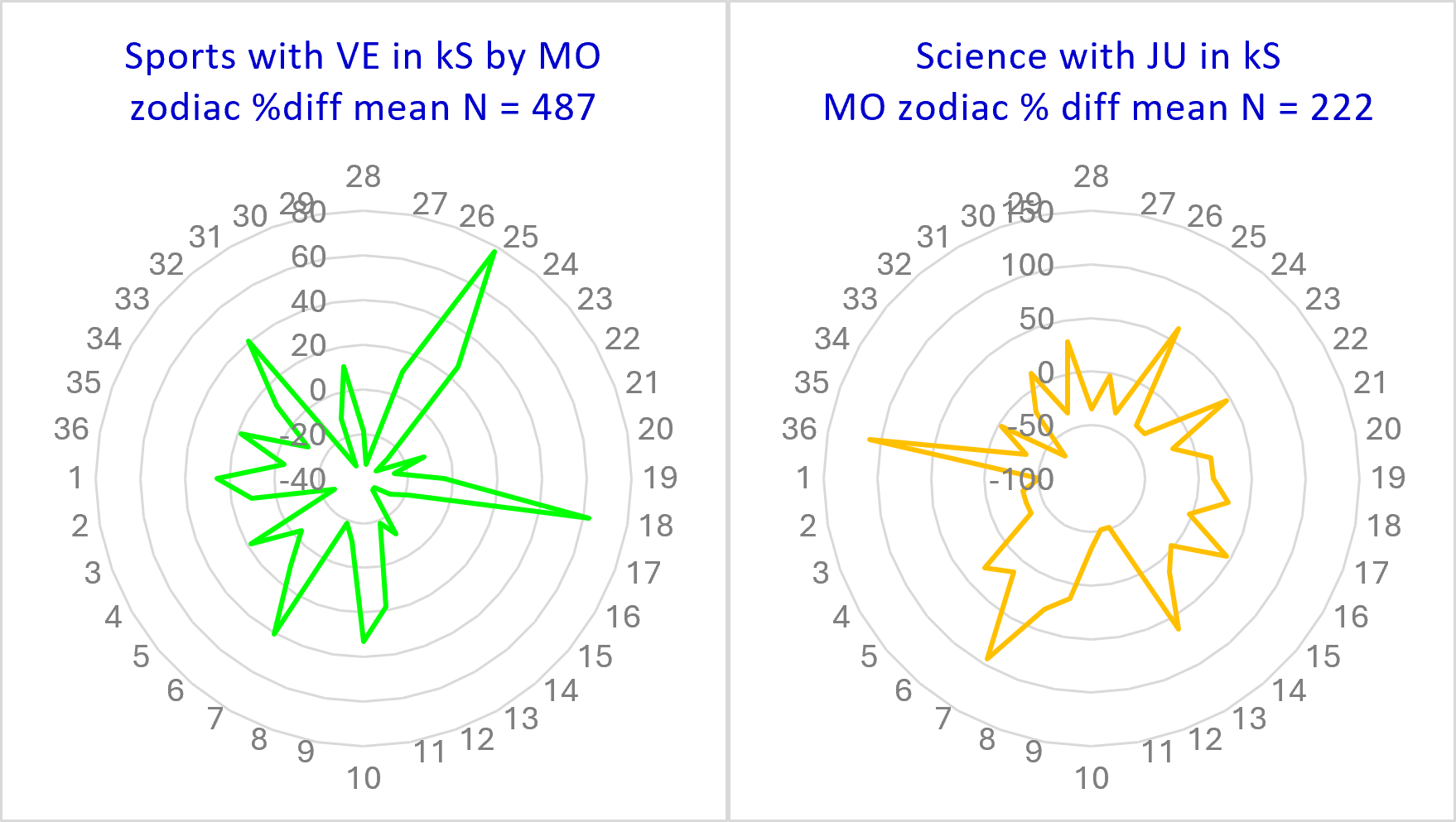
In order to look for signs of 27.3-day peaks correlated with Gauquelin Effects in other professions it is easier to adopt the reverse strategy of extracting births with a planet in Gauquelin Key Sectors (kS = Gauquelin sectors 36- 3 and 9-12 combined), and this can be done whether that planet was in surplus (e.g. MA for Sports Champions) or deficit (JU for Scientists).
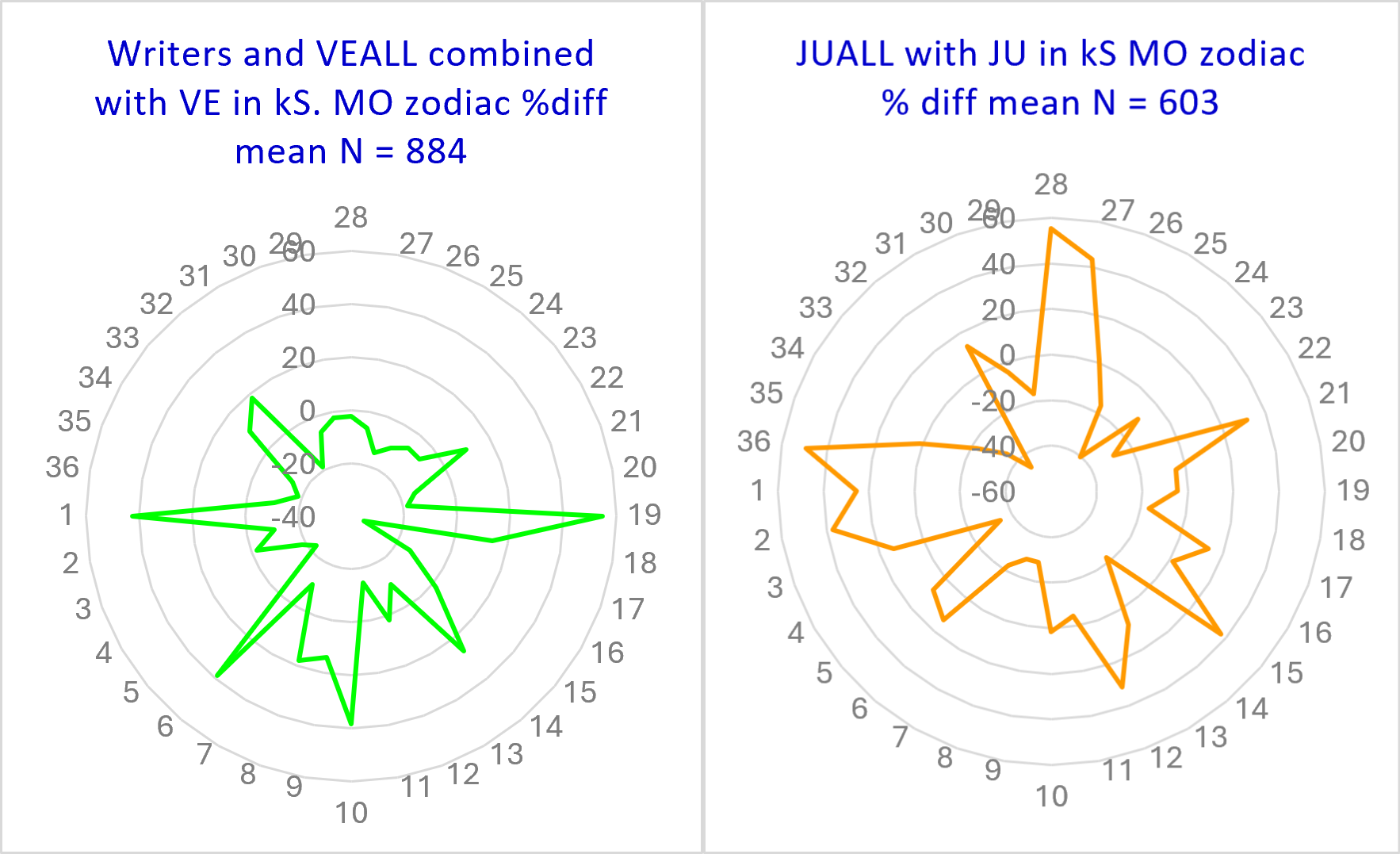
Figure. 3
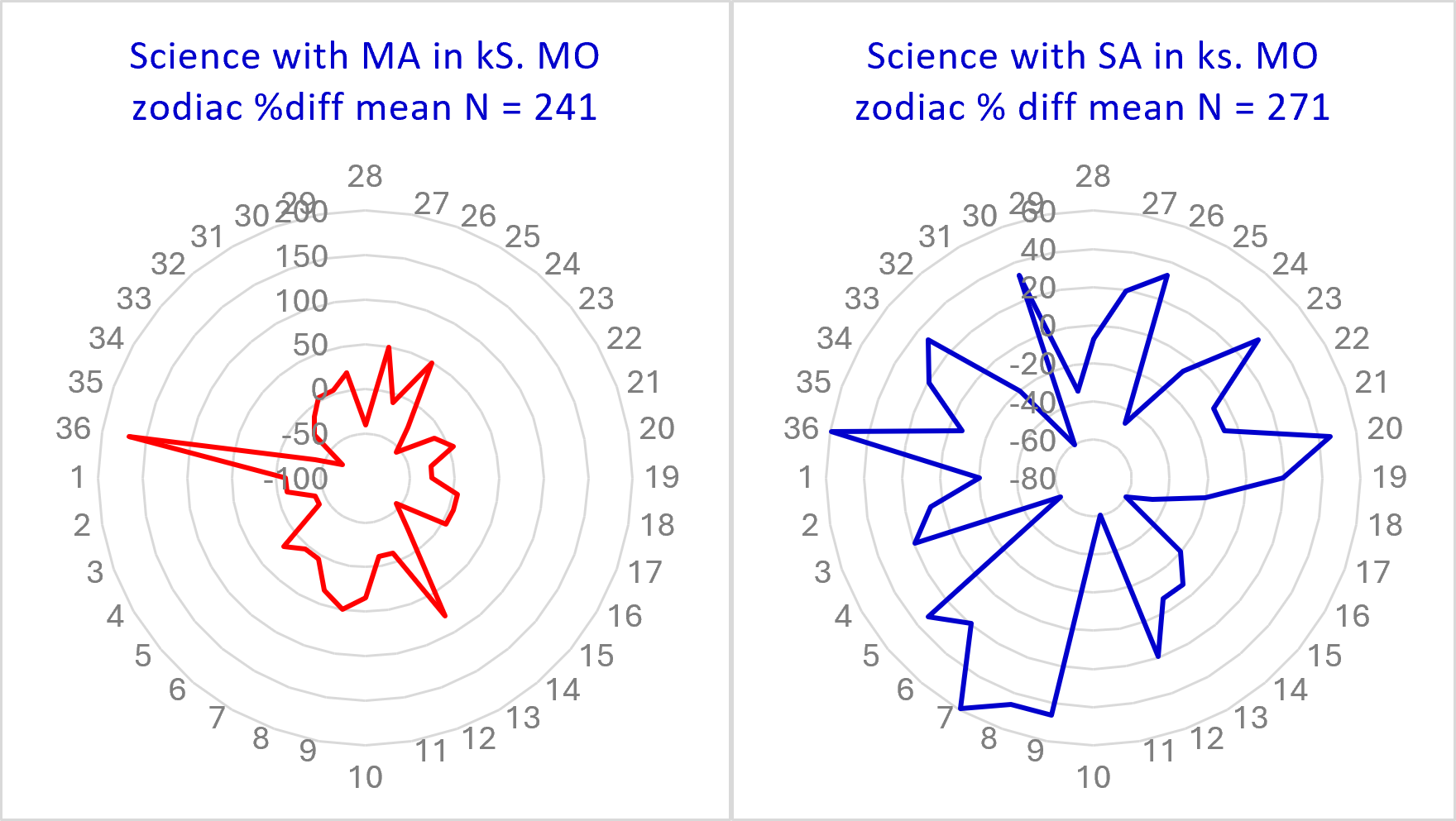
Some datasets plotted by MO - Zodiac longitude. Percentage deviations expected from the whole profession or the mean of the selected data, as labelled. The peaks are in different places from those of both Writers and Scientists (Fig. 3), suggesting that this cycle varies with profession and/or Gauquelin planets. VE in key sectors, for Sports Champions (not in surplus) has MOZod peaks in the same region as Scientists, while for Painters and Musicians combined (VEALL) the peaks are overlapping cardinal signs, and for Actors and Politicians (JUALL) they are fully into cardinal signs and broader. Scale on perimeter of circles: 36 numbered decanates starting with 0 – 10°of AR.
One obvious question arises now – if these 27.3-day cycle influences are related to solar activity, then can we see a modulation of the short by the longer Sunspot Cycle? And before we investigate this, we need to consider how to filter our data into high and low solar activity periods.
The 11.2-yr Schwabe cycle – a new way to examine it
In previous work, published data from the Belgian National Observatory was used to identify periods when solar activity was within about a quarter of a cycle on either side of the peak to create a ‘High solar’ data set. This method therefore stacks successive Schwabe Cycles removing possible evidence of other important cycles, including the Double Sunspot Cycle, every two Schwabe cycles and the approximately 90-year Gleissberg cycle. It has been pointed out that the SA-UR conjunction cycle corresponds to four Schwabe cycles (Scafetta 2012, Scafetta and Bianchini 2022), and this cycle can be studied very easily with standard astrological software, once the Belgian data has been used as a ‘calibration’ to locate the Schwabe cycle peaks within it. This is shown in Fig. 4, which is a plot of the total Gauquelin Professionals’ birth data (N = 15809) against the phases of the heliocentric SA-UR conjunction cycle. The period of the SA-UR cycle is 45.46 years, which corresponds well to four periods of the Schwabe cycle, period of about 11.2 years, at least over the range of years included here.
It should be mentioned that this may or may not mean that the SA-UR cycle itself is a zeitgeber for solar activity, because the same cycle length may arise from harmonic combinations of shorter planetary conjunction cycles (Stefani et.al 2023).
Figures 4a & 4b
At left, showing the % deviations of High Solar birth frequencies (N = 7979) from the mean of birth frequencies of all Gauquelin Professionals between 1805 – 1945, N = 15809 across the phases of the Saturn-Uranus conjunction cycle. The peak phases of the Schwabe cycles are very evident, allowing their phases in the SA-UR to be identified. On the right are shown the data for Actors and Politicians combined (labelled JUALL) with JU in key sectors 36-3, 9-12 (N = 603), as % deviations from the levels expected from the whole data (N = 2410). Highly significant deviations of the frequencies in the high solar zones (Chi- Squared (df = 1) of 19.6 but see discussion below.
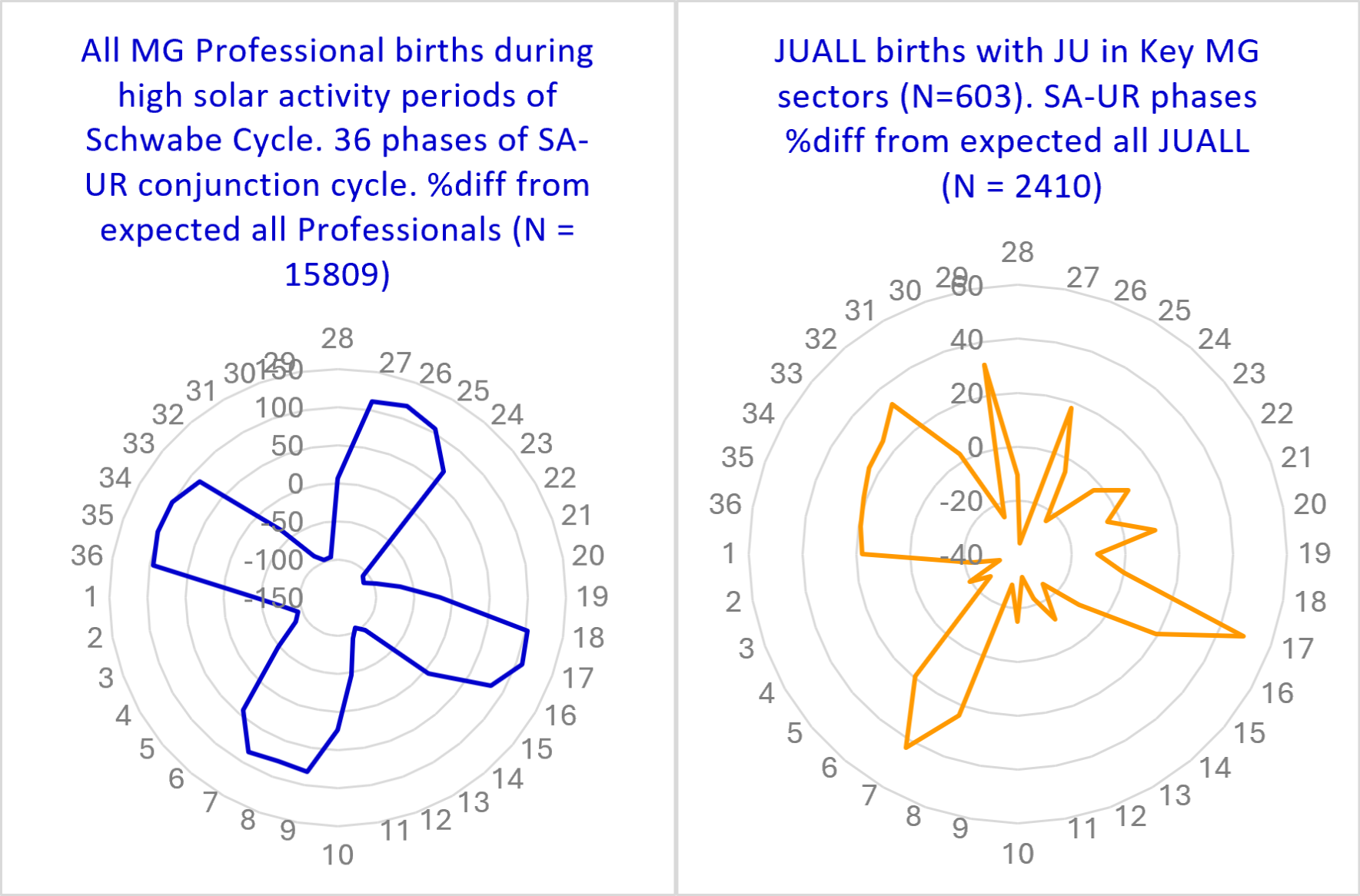
Plotting Gauquelin data against the SA-UR cycle allows us to immediately see where the peaks in each profession lie, and in several cases, we see that there are less than four peaks. It also allows the researcher to quickly determine whether a particular profession or Gauquelin planet is associated more with positive of negative halves of the Schwabe cycle, or neither, and to measure effect sizes and statistical significance.
However, there is an important caveat, pointed out by Suitbert Ertel (2015) which researchers need to keep in mind, illustrated in the right-hand graph. A similar pattern emerges only for JU, when all the professional sets are combined irrespective of whether they have positive or negative JU Effects. This is probably because the 11.2-year Schwabe cycle is similar in period to that of JU in the zodiac (11.86 years), which means that when JU in a Gauquelin sector above the horizon is selected it will tend to show an excess when JU is in the first half of the zodiac, and the contrary applies when JU is below the horizon.
One aim of this study should be to attempt to determine the SA – UR phases characteristic of each profession, and/or Gauquelin planet. A preliminary assessment suggests that Jupiter professions and births with JU in key sectors are more common when:
A) Solar activity is approaching the peak of the Schwabe cycle, and
B) The Moon zodiac position is between the 3rd decanate of Mutable signs and the 2nd decanate of Cardinal signs.
Some other professions tend to the opposite conditions, such that:
C) Solar activity is in the less active half of the Schwabe cycle, and
D) The Moon’s position is between the 3rd decanate of Fixed signs and the 2nd decanate of Mutables.
If we consider that social and psychological characteristics are influenced by solar activity then this would likely have had evolutionary survival implications, and the very fact of the existence of a multiplicity of personality types in humans and other animals may be included in this. So, following the same train of thought it would not be surprising if each cyclic influence encouraged or correlated with two opposing characteristics, whether in personality or sociological variables.
It is interesting that the four major angles, the conjunction, opposition and square of the SA-UR cycle fall on the descending portions of the Schwabe Cycle, where geomagnetic storms also peak (Reyes et. al., 2021).
Another question implied from progress so far is to investigate whether there is any consistent correlation in each profession (or for each planet) between the preferred phase of births in the two cycles here studied – the 27.3 - day cycle and the Schwabe cycle of solar activity.
As noted above, there was no significant enhancement of the Lunar zodiac deviations among Writers or Scientists when births with any one of the Gauquelin planets in key sectors were filtered out. The lunar zodiac peaks for these two professions were also examined in relation to heliocentric planetary conjunction cycles and again nothing systematic was observed. However other professional groups examined above do show evidence of interaction between the 27.3-day cycle and the Gauquelin planetary effect.
Major and Minor plus-zones
A further question is to ask whether the so-called Gauquelin plus-zones are affected differentially by the 27-day cycle. A major part of the Gauquelin planetary effects is associated with sectors 36-3 (across the Ascendant) and 9-12 (across the MC), but the Gauquelins also observed smaller effects in two narrower zones opposite to these: sectors 19-21 following the Descendant and 28-30 following the IC.
Below are shown two pairs, involving the planets VE and MA in major and minor +-zones see caption.
Figure 5
Comparing two professions across the SA-UR cycle depending on whether a Gauquelin planet was in major (sectors 36-3, 9-12) or minor +-zones (19-21, 28-30). It can be seen that in each member of the pair the peaks fall almost entirely in the gaps between the peaks of the other.
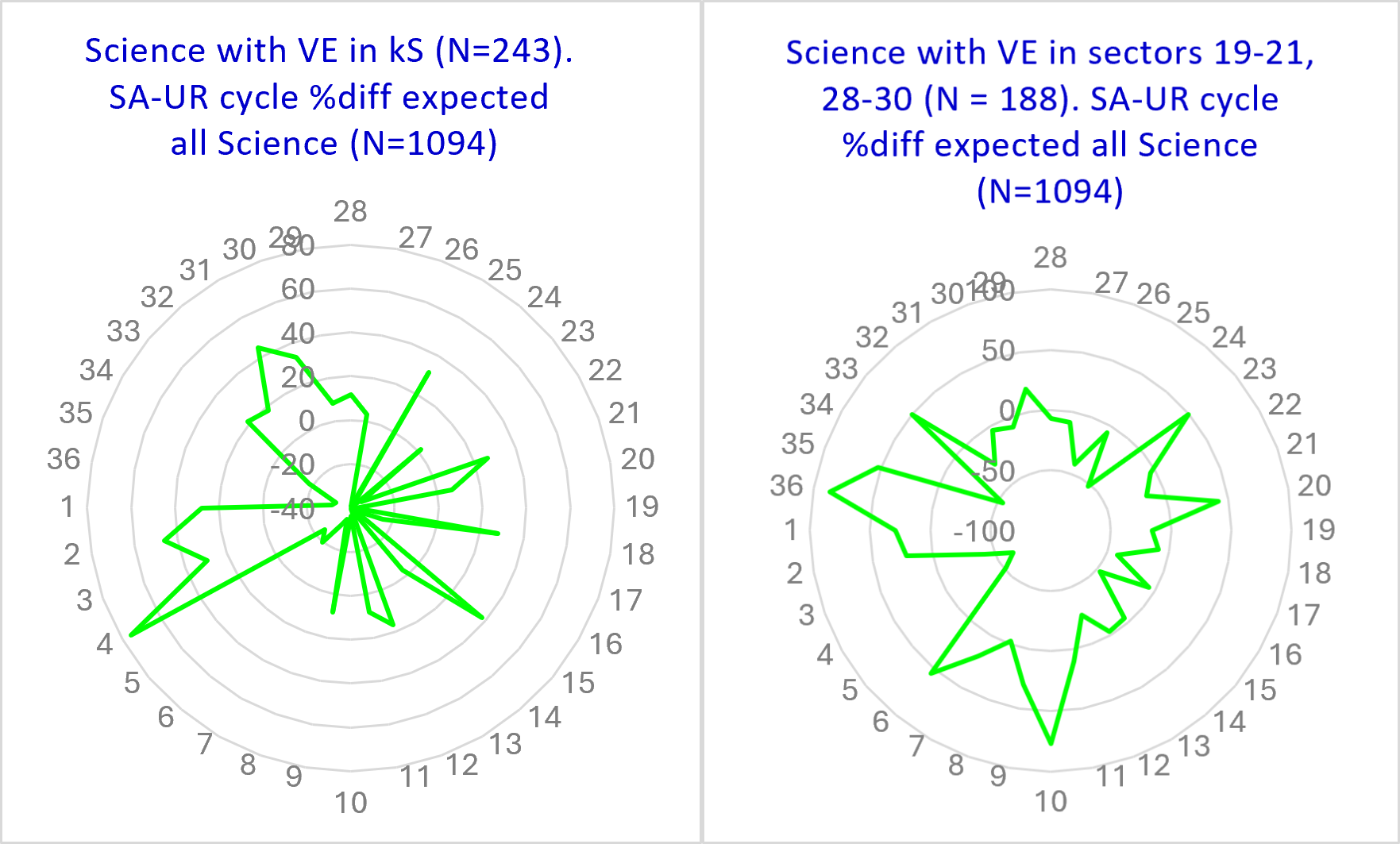
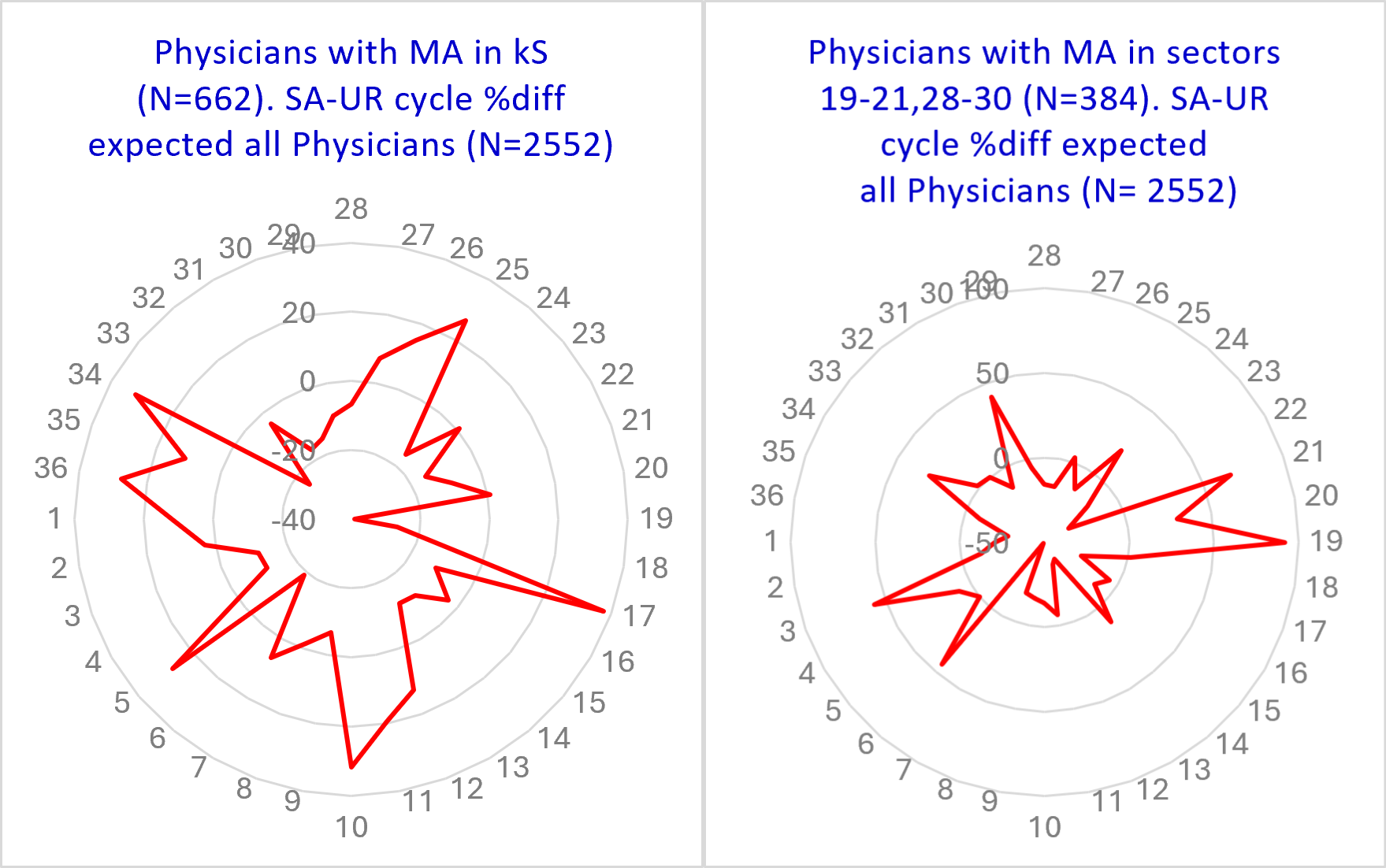
This brief example reveals a potential new insight. For VE in the Science data, the major zones have SA-UR peaks in the low solar-activity regions, and the minor peaks are in high-activity zones – the reverse pattern, seen in the MA data for Physicians, suggests a new detail of how solar activity may influence the Gauquelin Effect: differentially between the major and minor plus-zones.
Figures 1 to 3 and Fig. 5 have shown evidence of correlations between planets in Gauquelin sectors with both the Moon in the zodiac and longer-term solar activity tracked by the SA-UR cycle. We are left with the third side of the triangle, is there any correlation between the 27.3-day cycle and that of SA – UR? I was only able to find one, which is shown in Fig. 6. This disparity will be taken up in the Discussion section.
A Chi-Squared Contingency test (Df=1) was calculated comparing the frequencies in the two opposing peak sectors where the SA-UR phase was in the ranges 0-300 (sectors 1-3) and 1900-2100 (sectors 20-21, and gave the value 11.01, p = 0.0009, and Cohen’s w = 0.100.
Figure 6. Birth frequencies of Gauquelin Scientists across the SA-UR cycle. On the left the whole data set plotted as % deviations from the mean; on the right the same after selecting births in the peak ranges of the Moon Zodiac cycle – MO in the second and 3rd decanates of GE, SG and PI, N = 241, plotted as % deviations from the expected frequencies calculated from the first graph.
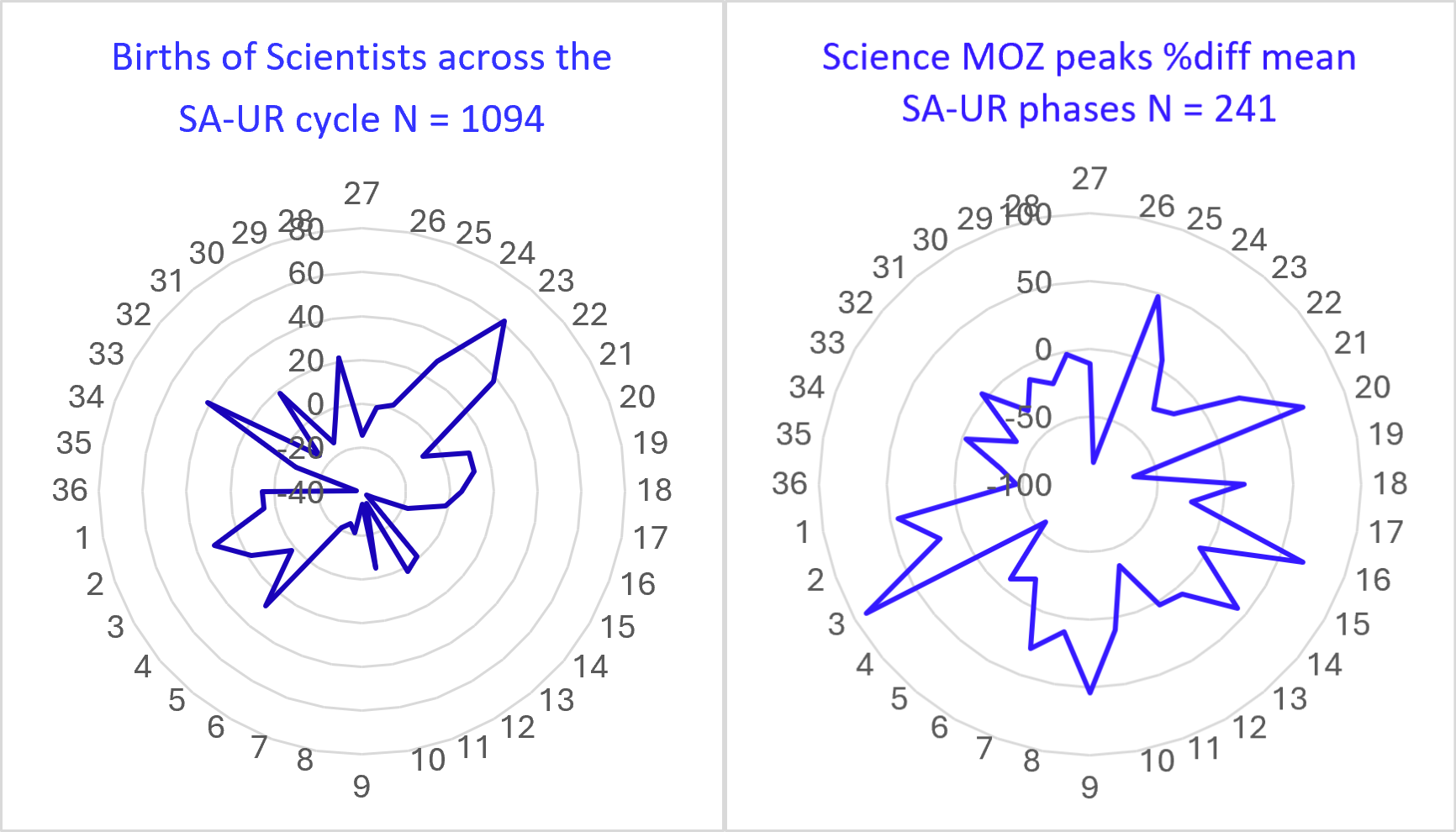
It is interesting to note that these ranges of the SA-UR cycle correspond to the descending phases after the peaks of the Schwabe Cycle.
Statistical evaluation
An a priori hypothesis is considered essential to assess statistical significance. This not possible in the present investigation, but the criterion of interest in all cases is the presence of peaks separated by multiples of 90°. Where data is split into exclusive parts such as Apogee and Perigee, a Chi-Squared Contingency Test is legitimate.
There is clearly a tendency for the peaks in figures 3 and 5 to display large peaks separated by multiples of 900 or nearly so, which is difficult to attribute to chance.
The Chi-Squared test measures the probability that the deviations from regular distributions are due to chance. Effect Sizes in all cases were calculated from Chi-Squared values using Cohen’s formula:
w = SQRT(Chi-Squared/N), (from SPSS tutorials, cited in Currey (2022).
The statistical results given with the figures above and two sets that were published in Part 1 are summarized in Table 1.
Table 1
This table summarizes the key astrological parameters for each of the datasets and provides relevant statistical information calculated from them.
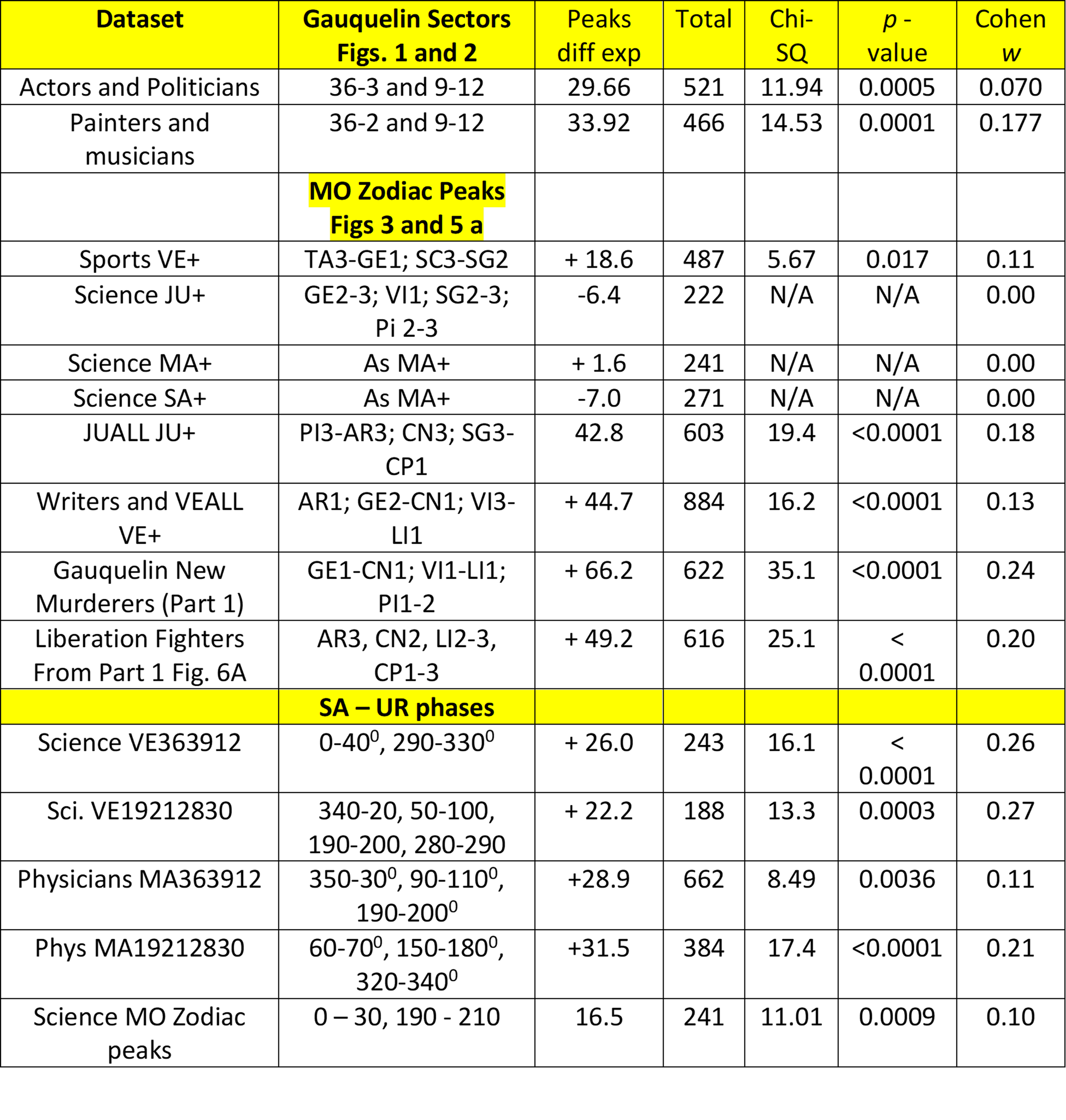
Summarizing the statistical calculations: only graphs with visible structure among their peaks are calculated, the others are illustrative for readers to see the variety of patterns. VE+ means VE in sectors 36-3 and 9-12, etc. The minor peaks produced weaker and sometimes different patterns. Differences are calculated relative to the sample mean except for Science where for MO in Zodiac they are calculated with respect to the expected peaks in the whole profession, to illustrate the effects of different key sector planets. The peaks in mutable signs seen in Fig. 4A are also observed for JU+, and partially for MA+, but peaks have appeared in different places instead in the case of SA+, and also but differently for VE+, not shown. For SA-UR graphs differences relative to the whole profession were used to show the effect of the planet.
Discussion
It is useful to list the conclusions of this report before entering a detailed discussion.
1. There is no consistent correlation between the planets which show positive Gauquelin Effects and the presence of peaks in the MO zodiac distribution, but some examples are quite striking.
2. It was not possible to say that the peaks in the 27.3-day cycle are unambiguously correlated with purely solar or lunar influences, so both must be kept in consideration in future work.
3. The new technique for investigating solar activity effects related to the Schwabe Cycle has proved successful and has revealed a new phenomenon – the strong difference between birth distributions across the SA-UR cycle depending on whether a Gauquelin planet is in a key sector (36-3 and 9-12) or a minor plus-zone as defined by the Gauquelins (sectors 19-21, 28-30). And it is important to note that this is observed even when the Gauquelin planet is not recognized as significant for a particular profession, such as VE in the case of Scientists, shown in Fig. 5. This may turn out to be an important new avenue for investigation.
4. There is little evidence of correlation between the Moon zodiac cycle and the SA-UR cycle, thus the former is probably not a mediator between the SA-UR cycle and the diurnal variations which form the basis of the Gauquelin Effect.
5. Although longevity was not addressed in this study, these results combined with those reported in Douglas (2025) suggest that longevity may offer more insights and is currently being pursued by collecting dates of death for the people in each Gauquelin professional database.
One of the questions raised in the introduction was whether the patterns in the Moon’s zodiac cycle correlate consistently with professions showing surpluses of Gauquelin planets, and the answer seems to be that this is only observed in some cases, involving VE and JU. Both Scientists and Writers show striking MO-Zodiac T-Square patterns in the professions as a whole, yet the Saturn surplus in Gauquelin key sectors for scientists shows no enhancement when the Moon is in its peak zodiac sectors, and only Venus is strengthened in key sectors when the MO-Zodiac peaks are selected.
The planets whose Gauquelin Effects do correlate with the Moon in the zodiac, VE and JU are also, with the Earth, two of the three planets with the greatest tide-raising effect on the Sun, and the three pairs of conjunction cycles they form correlate closely with the timing of the sunspot cycle and the 22.2-year cycle (Scafetta 2012, Grandpierre 1996). It is also interesting that the Mars Effect seems to correlate strongly with the EA-JU conjunction and only with EA-MA after peak sectors in the EA-JU cycle are selected (see Douglas 2020).
As described in Fig. 2b, the surplus of VE in key sectors that was found after filtering in the peak range of MO in the zodiac (N = 466) was more than enough to account for the whole surplus in the Painters and Musicians (N = 2720). In the case of JU in the Actors and Politicians data, it was sufficient to account for 52% of the observed total.
Both the Gauquelin New Murderers (N = 622) and Liberation Fighters (N = 616) show peaks in the Moon zodiac cycle separated by 900 elongation, but these data sets are too small to filter further by planets in key sectors. We can note that the Moon zodiac peaks for Murderers are almost entirely confined to mutable signs, which was also observed in a small collection of serial killers (Douglas and Ruis, 2009), so this constitutes a replication or perhaps it would be better to say that serial killers are a subset of murderers in general, so Ruis and Douglas’s study is more like a confirmation of Gauquelin’s earlier one, which Douglas and Ruis do not refer to. Using data kindly provided by Jan Ruis it was found that that only one murderer appeared in both sets, so the two sets are effectively independent.
Evidence presented above was not sufficient to decide whether the 27.3-day periodicity is solar or lunar, so one possibility is that the two are acting synchronously. The solar rotation period varies between the solar equator and the poles, and a period of 27.3 days (as observed from the moving earth) corresponds to a low heliographic latitude. And this in turn leads to a prediction that synchronization will happen near the end of the 11.2-year Schwabe cycle. We can say this because it is well established that sunspots emerge at about 30°N and S of helio-centric latitude and migrate gradually toward the solar equator together, producing the so-called Butterfly Diagram.
Although it is suggested here that the peaks in the 27.3-day cycle originate from the heliographic ‘active longitudes’ on the solar surface this does not exclude a connection between such solar effects and the lunar zodiacal cycle.
If we conjecture that the sharp lunar zodiac peaks are tracking active longitudes on the Sun, then what does it mean to plot the ‘phases’ of say the geocentric MO – JU cycle? If a pattern emerges around the conjunctions or oppositions, it may represent times when the active longitude, stimulated by JU is pointing towards the earth. This is a topic for further study, and Scafetta and Bianchini (2022: 7) have indicated the relevance of combination cycles of the solar rotation with the orbits of the planets.
Another question is whether the Lunar zodiac influence might be one that discriminates between the Gauquelin planets, or does it potentiate, weaken or remain independent of all of them? As noted above, there was no significant enhancement of the Lunar zodiac deviations among Writers or Scientists when births with any one of the Gauquelin planets in key sectors were selected. The lunar zodiac peaks were also examined in relation to heliocentric planetary conjunction cycles and again nothing systematic was observed.
Looking at the data in Figure 5 above we see that there are several examples of correlations between planets in Gauquelin Sectors and certain clearly distinct phases of the SA – UR cycle. And in Figs 1 – 3 there are correlations between planets in Gauquelin sectors and the Moon in the zodiac. What is much less evident is the third possible correlation between the SA – UR cycle and the Moon in the zodiac. From this we can take a preliminary conclusion – that the 27.3-day cycle, whatever its origin, is not an intermediary between the long-term solar activity cycles and the distribution of planets in Gauquelin sectors.
The SA-UR cycle opens a new and much easier way into studying solar activity effects for anyone with standard astrological software. The author is happy to make available to researchers a list of the high solar activity periods collected from the Belgian Royal Observatory site. Another advantage, apart from simplicity and ease of calculation of p-values and Effect Sizes, is that we actually learn more about the impact of the Schwabe Cycle by this method, because it allows for the possibility that some cycles in each set of four within a SA-UR conjunction cycle may be more influential than others. And it opens space for the 22.2-year solar cycle to be visible if we see two opposing peaks. These are considerable improvements for researchers.
It is interesting that what we may call the four ‘key phases’, 00, 900, 1800 and 2700 of the SA-UR cycle fall on the descending portions of the Schwabe Cycle, where geomagnetic storms also peak (Reyes et. al., 2021), suggesting that geomagnetic activity may be a mediating path for solar effects on human birth and longevity.
An important point emerges when we consider the Effect Sizes, as measured by Cohen’s w. Ranging between 0.10 – 0.15, they are classified as low effect, but we must remember that the Gauquelin Effect itself produces lower values, less than 0.05 when calculated as kappa (Dean et. al., 2016: 107), although there are some problems with the use of Cohen’s kappa as an Effect Size (Currey, 2022, pp. 52-53). Then there is the question of the reference distribution to use when calculating differences from expected values. It seems obvious to compare the observed Moon Zodiacal position frequencies for subsets with a given Gauquelin planet in a plus-zone, with the Moon Zodiacal position values in the same profession as a whole, but another useful comparison is how much of the respective Gauquelin Effect correlates with the peak phases of the Moon Zodiacal position.
Gerhard Mayer (2021) pointed out that zodiac signs should not be taken as self-evidently valid divisions, when other ways of dividing the ecliptic are available for comparison. And in this study my use of zodiac decanates for the Moon’s position is in no way aimed at demonstrating the validity of zodiac signs, it simply refers to the question of the existence of 27.3 -day cycles and whether they can be attributed to Lunar or to Solar influences, or to both. Even solar physics and astronomy are fundamentally dependent more on data than on theory (Judge 2020:66).
There is another caveat which has not been addressed here – the possible extent to which the 100 categories themselves may create dramatic impressions. This is brought out clearly in the case of the Scientists with MA in key sectors, shown in Fig. 5: the single very narrow peak in sector 17 becomes spread over two sectors when a shift of 50 or half a division is applied to the origin of the scale of zodiac degrees, which the Jigsaw software is set up to allow. This does not dispose of the issue of course because there is no reason to assume that only using the zero degree of Aries rather than 50 as a starting point is likely to produce an artefact: it can work in the opposite direction too (see Yanez 2016 for discussion). For the data presented here, most peaks are broader than one 100 sector, so this issue was not considered further. The key point of interest is the existence or not of significant peaks separated by multiples of 900.
It is also important to recognize the wider relationships that may exist beyond those connected with human health. Longevity has been shown to correlate significantly with solar activity at birth, (Davis and Lowell, 2004, 2006, 2008) and many studies exist that reveal correlations between geomagnetic activity and various human health issues such as cardiac crises and strokes, as discussed in Part 1 (Halberg et al 2013; Hastie et al 2019; Juckett and Rosenberg 1997; Montag et al 2013; Skjærvø et al 2015; Stoupel et al 2011).
If confirmed on contemporary data 27-day cycle effects may indeed prove useful in the fields of medicine and insurance, despite the sceptics’ doubts. As mentioned above, the work of Düll and Düll (1934) indicated that cardio-vascular diseases at death peaked at a different phase of the 27-day cycle from nervous system diseases. The data on SIDS are more equivocal than those for longevity, but this topic also holds interest.
Longevity represents a more general concept, independent of specific health issues, and since it has been shown that average longevity varies between professions (Epstein and Epstein, 2013) and is correlated with fame, for musicians at least (Hepp et al, 2025), a next step, already begun, will be to investigate the Gauquelin professional data in relation to longevity. This requires time and patience to collect individual dates of death for all the eminent professionals in the Gauquelin collections and is being carried out in conjunction with Thierry Graff and his OpenGauquelin project (https://opengauquelin.org/). By considering both birth and death, and the cause of death, it will change the overall context of astro-research from testing natal astrology to the socio-psychological experience of being human on planet earth, immersed in solar-terrestrial influences.
Can social phenomena explain the Gauquelin Effects?
An important point often raised by Geoffrey Dean and his collaborators is that the Gauquelin Effect is too small, even among eminent professionals to be practically useful to astrologers or anyone else (Dean et al. 2016: 107). And they follow up by saying that social and historical explanations must first be eliminated before – in their opinion – the much more extraordinary hypothesis of planetary influences can be considered (Dean et al. :104-106). Ertel published a series of five papers rebutting all their proposed examples of social mechanisms, (see Ertel 2005, and Phillipson 2022).
We should talk about social influences, but there is another side to this story, which is that eminent professionals have had a disproportionate social influence beyond their numbers throughout history. And specifically in relation to my current work on human longevity and fame (Douglas 2025), here is a case where the social and the solar-terrestrial may turn out to be entwined, so the whole point will be not to separate them.
And we can go further, because human longevity has been linked to certain personality dimensions. Conscientiousness, marked by traits such as industrious, dutiful, self-disciplined, cautious, has consistently been found to correlate with longevity, followed by Extroversion and Openness in the Big Five dimensions. The Eysenck Personality dimensions of E and N have been shown to correlate with the Gauquelin Effect for different professions, in both European and US data (Gauquelin et al. 1979, 1981) so if longevity is confirmed as a new variable in studying solar-terrestrial correlations of eminence, it may also correlate with personality, and there is already evidence for this (Masui et al. 2006, Stephan et al. 2025).
Besides Conscientiousness among the Big Five personality dimensions, longevity also correlates positively with Openness, aspects of Extraversion and Agreeableness, and negatively with Neuroticism (Stephan et al. 2025). But the nuances are important, and although there is an overall tendency for scientific researchers to score high on Conscientiousness – and its Saturnian traits – there are important variations depending on their field of research (Kolomiets, 2026). Eminence in each profession requires more than the baseline personality profile, for example, in the field of science Conscientiousness needs to be combined with high Openness scores, as a wide-ranging study of professions has shown (Anni et al. 2025). In relation to these new studies, it is worth noting that the Gauquelin database of Scientists covered a wide range, including, physicists, chemists, biologists, social scientists and mathematicians, as became apparent during an online search for biographical details (Douglas in preparation).
As a quick snapshot of longevity profiles I have so far investigated, the percentages of deceased nonagenarians among Gauquelin scientists, writers, actors and politicians varied between 8.7% (scientists) to 11.9 % (actors), while for centenarians the actors stood out with 0.91% compared to 0.4 – 0.5% for the other professions. But the really striking figure emerged when Nobel Physicists and Chemists were examined, after removing the small number of duplicates with the Gauquelin scientists, and there were 59 deceased nonagenarians among a total of 285 (20.7%). This latter result may simply reflect a correlation between fame and access to top-notch health care, but eminence may also be a factor. This points up the complexity of causes in this kind of research, as suggested in Fig. 7.
Eminence in the Gauquelin data may need to be refined, and who knows, the much-derided Character Traits Hypothesis (CTH) may come alive again.
In line with the approach described in my earlier paper (Douglas 2025), and another in development, I believe that it is important to understand what kind of causations are operating here, and the fundamental starting point is that there is no plausible physical direct cause linking a planet’s position in the sky at birth with the character of a child born at that moment. I believe it is a profound mistake to prefer to try to explain an influence which is so obviously implausible, when there is an indirect pathway which does already have empirical support in both its stages. The planets act as zeitgebers for solar activity (see Scafetta and others), while solar influences are transmitted directly to earth via radiation, and by the solar wind impacting the magnetosphere and the ionosphere. The sceptics agree that the planetary effect is physically inexplicable and deduce that it must therefore have a social explanation. But if the influence is transmitted via the Sun, then it is no longer implausible.
I offer the following preliminary map of causations (Fig. 7), based on material reported here, in Part 1 and in Douglas (2004) on Birth Order.
Fig. 7. A possible network of causal relations leading to birth
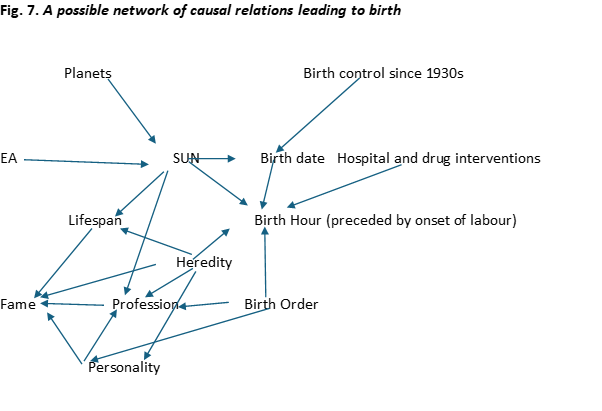
Two features are worth mentioning – Planetary influences are shown as only passing via the Sun, as I believe direct influences are not plausible, whereas the planets have a time-giving influence on solar activity cycles, and birth control has been given a place.
Techniques of controlling conception began to be widely adopted in Europe in the 1930s and this may well explain why the third Gauquelin Heredity experiment produced no significant results. Even though both sets of births were collected at the same 12th Arrondisement hospitals in Paris, and both showed similar nycthemeral curves typical of natural births, (M. Gauquelin 1985, 1988), those collected between 1931-39 showed no heredity effects in key sectors, while the births between 1923-31 did. Each study involved over 5,900 parent-child comparisons (M. Gauquelin 1988: 63, M. Gauquelin 1985).
The Gauquelins were well aware of the destructive effects on their data of induced labour, which is why they did not use data on births after 1945, but they seem to have treated the hour of birth and its possible heredity effects as being independent of the date of birth, and this may prove to have been a mistake.
The birth control hypothesis also leads to another comment – since its advent is an eminently social phenomenon, then in line with the concerns of Dean and his associates it should be excluded before we can say that the third Gauquelin Heredity Experiment negates the results of the previous two. Given the care and effort that went into all three experiments, the situation is surely that there are now two results to explain – success in the first experiment and failure in the third.
Most astrologers would see that birth hour, and birthdate should not be separated, which might make the Gauquelin research seem naïve, but this observation needs to be contextualized. The Gauquelins completed an extensive study of planets in the zodiac signs (1978) for each of their professions and found nothing to indicate a significant correlation – except for the Moon for writers and scientists of course. It is interesting now to consider what the current model has to say, because it points up a difference from the astrological model, while both models recognize that attempting to separate the hour of birth from the date is a mistake.
The astrological model emphasizes the idea of cosmic wholeness at the moment of birth – Dane Rudhyar made an important distinction when he said that the planets modify the influences which emerge fundamentally from the Sun and the Moon (Rudhyar 1969: the Sixth Step). The bio-physical approach I am pursuing views birth as one stage in a whole process stretching back at least to conception and to the decision of two people to have a child, assuming that rape was not the cause of conception. But there is a difference in the way that the processes are treated, most obviously by my use of heliocentric rather than geocentric conjunction cycles, because the model depends on the effect of heliocentric cycles on solar activity.
Both approaches also potentially recognize conception as an important moment, but for practical reasons it is not possible to identify the hour of conception, although the date can be identified if preparations are made. But there are no historical databases available for research on this, to my knowledge.
The standard astrological research method potentially recognizes that birth is just one moment in a process, but it somehow hopes that all the information contained there is synchronically encapsulated in the condition of the sky at birth. To take a more holistic perspective diachronically, the model of research I am discussing investigates planetary cycles which are running all the time not just at birth. In this way new correlations can be uncovered linking births on one day with longer term solar-terrestrial cycles. And the validity of this is revealed especially in Fig 5 of this paper and Fig 12 of Douglas (2020) where the peak times of birth are shown to change dramatically for certain professional groups, depending on the sunspot cycle.
The Sun has a crucial role in the present theory and in the astrological model, but while the astrologer gives great importance to the interpretation of the Sun in its zodiacal and house positions as well as any geocentric aspects, the present model asks how solar activity cycles were affected by heliocentric conjunction cycles, and what the effects of solar activity were at the hour of birth on earth. It is a theory being tested and so cannot rush straight to interpretations based on supposed meanings of the zodiac signs and houses, however venerable.
Finally, I would like to emphasize that the data here reported on the Moon’s zodiac cycle are not presented in pursuit of any pre-conceived theory, whether physical or astrological – they are new data that surprised me as much as the reader may possibly be surprised. They do not obviously fit any scientific or astrological theory, and I believe that acknowledging anomalies is a crucial function for science – it corresponds perhaps to the freedom demanded by the artist not be constrained by the strictures of existing opinions.
Acknowledgements.
For Part 1, I am grateful to the curators of the MacTutor website, Edmund Robertson and John O’Connor for their help in formatting their data for Excel, to Dr Kyösti Tarvainen for pointing out their site to me. I also had useful comments from Dr Rodney Jones, a medical statistician. And for both parts, I am extremely grateful for Robert Currey’s editing skills and his patience with my slow responses at times.
References
Anni, K., Vainik, U. and Mottus, R. (2025). Personality Profiles of 263 Occupations. Journal of Applied Psychology, 110(4): 481-511.
Downloadable at: https://doi.org/10.1037/apI0001249
Berdyugina S V and I. G. Usoskin (2003). Active longitudes in sunspot activity: Century scale persistence. Astronomy & Astrophysics, 405, 1121–1128.
Currey, Robert (2022) Meta-Analysis of Recent Advances in Natal Astrology using a universal Effect Size. Correlation 34(2): 43-56.
Davis and Lowell (2008)– gender ratio at death affected by solar radiation
https://www.sciencedirect.com/science/article/abs/pii/S0306987708003447?via%3Dihub
Davis and Lowell (2006) – radiation damage solar activity peaks illness and creativity variations https://www.sciencedirect.com/science/article/abs/pii/S0306987706001824?via%3Dihub
Davis and Lowell (2004). The Sun determines teratogenic effects of radiation and hence longevity.
https://www.sciencedirect.com/science/article/abs/pii/S030698770400221X?via%3Dihub
Dean, Geoffrey, Mather Arthur, Nias David and Smit, Rudolf (2016). Tests of Astrology: A critical review of hundreds of studies. Amsterdam: AinO Publications.
Douglas, Graham John (2004). Illusions and Explanations: The Gauqelin Effect and Birth Order. Published onn the CURA website http://cura.free.fr/xxx/30doug3.html
Douglas, Graham J. (2021). Is the Gauquelin Effect born at conception? Michel Gauquelin’s intuition on geomagnetic micro-pulsations. Correlation 33(1): 10-40.
Douglas, Graham J. (2022). Human longevity, the Gauquelin Effect and Helio-centric cycles. Correlation 34(1): 59-76.
Douglas, Graham J. and Ruis, Jan (2009). A comment on serial killers and extreme character types. Correlation 27(1): 59-60.
Düll, T. and Düll, B. (1934): Uber die Abhangigkeit des Gesundheitszustandes von plotzlichen Eruptionen auf der Sonne und die Existenz einer 27-tagigen Periode in den Sterbefallen, VirchowsArchiv fur pathologische Anatomie und Physiologie, 293: 272 – 319.
C.R. Epstein, C.R. and Epstein, R.J. (2013). Death in The New York Times: the price of fame is a faster flame. Q. J. Med., 106: 517-521. doi:10.1093/qjmed/hct077.
Ertel, Suitbert (2015). Personal communication.
Ertel, Suitbert (2005). Gauquelin planetary effects brought down to earth? On Geoffrey Dean’s dealing with stubborn facts. Correlation 23(1): 7-33.
Gauquelin, Michel (1978). Statistical Tests of Zodiacal Influences. Book I: Profession and Heredity. Scientific Documents #3. Paris: Laboratoire des Etudes des Relations entre Rythmes Cosmique et Psychophysiologiques, Paris.
Gauquelin, Michel (1980). The Cosmic Clocks. St. Albans: Paladin.
Gauquelin, Michel (1985). On the lack of positive replication of planetary heredity. Correlation, 5(1): 36-39.
Gauquelin, Michel (1988). Planetary Heredity. English edition, San Diego, CA: ACS Publications. (NB: this is different from the French edition.)
Gauquelin, Michel (1984). The Truth about Astrology. London: Hutchinson.
Gauquelin, Michel, Gauquelin, Francoise and Eysenck, S.B.G. (1979). Personality and position of the planets at birth: an empirical study. British Journal of Social and Clinical Psychology, 18: 71-75.
Gauquelin, Michel, Gauquelin, Francoise and Eysenck, S.B.G. (1981). Eysenck’s personality analysis and position of the planets at birth: A replication on American subjects. Personality and Individual Differences, 2(4): 346-350.
Grandpierre, Attila (1996). On the origin of solar cycle periodicity. Astrophysics and Space Science 243: 393 – 400.
Hafkamp, M.P.J., Slaets, J.P.J. and Van Bodegon, D. (2017). Intellectual maturity and longevity: late-blooming composers and writers live longer than child prodigies. Aging, 9 (5): 1432-1438.
Halberg, F.; Düll-Pfa_, N.; Gumarova, L.; Zenchenko, T.A.; Schwartzkop_, O.; Freytag, E.M.; Freytag, J.; Cornelissen, G. (2013). 27-day cycles in human mortality: Traute and Bernhard Düll. Hist. Geo Space Sci. 4, 47–59.
Hastie, Claire, Daniel F. Mackay, Tom L. Clemens, Mark P. C. Cherrie, Albert King, Dibben, Chris & Pell, Jill P. (2019). Antenatal exposure to solar radiation and learning disabilities: Population cohort study of 422,512 children. Scientific Reports, published online: www.nature.com/scientificreports
Hepp, Johanna; Heine, Christof; Schliebener, Melanie and Michael Dufner (2025). The Price of Fame? Mortality Risk among Famous Singers. J. Epedimiol Community Health. Published online at https://jech.bmj.com/content/early/2026/01/19/jech-2025-224589
Juckett and Rosenberg (1997). Time series analysis supporting the hypothesis that enhanced cosmic radiation during germ cell formation can increase breast cancer mortality in germ cell cohorts https://link.springer.com/article/10.1007%2Fs004840050043
Judge, Philip (2020). The Sun: A Very Short Introduction. Oxford: Oxford University Press.
Kolomiets, Peter (2026). Scientist and Researcher Personality Types: Which Profiles Thrive in Academic and Applied Research? https://jobcannon.io/blog/scientist-researcher-personality-type-guide
Lockwood, M., Owens, M., Barnard, L., Haines, C., Scott C.J., McWilliam, K. A. &. Coxon, J. (2020) Semi-annual, annual and Universal Time variations in the magnetosphere and in geomagnetic activity: 1. Geomagnetic data. Journal of Space Weather and Space Climate. Vol.10.23.
Masui, Y., Gondo, Y., Inagaki, H. And Hirose, N. (2006). Do personality characteristics predict longevity? Findings from the Tokyo Centenarian Study. Journal of the American Aging Association, 28(4): 353-361.
Maths history website and database. https://mathshistory.st-andrews.ac.uk/
Mayer, Gerhard (2021) The zodiac sign error: the sin of reification. Correlation: letter to the editor. Vol. 34(1): 92-94.
Montag Christian, Eichner Markus, Markett Sebastian, Quesada Carlos, Schoene-Bake Jan-Christoph, Melchers Martin, Plieger Thomas, Weber Bernd & Reuter Martin (2013). An interaction of a NR3C1 polymorphism and antenatal solar activity impacts both hippocampus volume and neuroticism in adulthood. Frontiers in Neuroscience, 7: 243. https://www.frontiersin.org/article/10.3389/fnhum.2013.00243
Muller, A. & Menzer, G. (1993). 1145 Angehörige deutscher Dynastien [1145 members of German dynasties]. Astro-Research Data 4. Waldmohr, A. P. Muller-Verlag.
NASA (2017). The Sunspot Cycle. https://solarscience.msfc.nasa.gov/SunspotCycle.shtml
Owens M J, Lockwood, M., Barnard, L.A., Yardley, S.L., Hietala, H., LaMoury, A.T., Vuorinen, L. (2023). Annual Variations in the Near-Earth Solar Wind. Solar Physics 298:111. https://doi.org/10.1007/s11207-023-02193-8
Pearl, Judea and Dana Mackenzie (2018). The Book of Why: The New Science of Cause and Effect. Harmondsworth: Penguin.
Phillipson, Garry (2022). Professor Suitbert Ertel interviewed. Correlation 35(1): 59-62.
Rudhyar, Dane (1970). The Practice of Astrology as a Technique in Human Understanding. Harmondsworth: Pelican Books.
And available at https://www.khaldea.com/rudhyar/pofa/pofa_6.shtml
Ruis, Jan (2008). Statistical analysis of the birth charts of serial killers. Correlation 25(2): 7 – 44.
Sawyer, C, (1974). Semiannual and solar-cycle variation of sector structure. Geophysical Research Letters Vol. 1(7): 295-297.
Scafetta, Nicola (2012). Multi-scale harmonic model for solar wind and climate cyclical variations during the Holocene, based on Jupiter-Saturn tidal frequencies plus the 11-yr solar dynamo cycle. Journal of Atmospheric and Solar-Terrestrial Physics 80: 296-311.
Scafetta, Nicola and Bianchini, Antonio (2022). The Planetary Theory of Solar Activity Variability: A Review. Frontiers in Astronomy and Space Science, 9:937930. doi: 10.3389/fspas.2022.937930.
Shea, M.A. and Smart, D.F. (1990). A summary of Major Solar Proton Events. Solar Physics, 127 (2): 297-320.
Skjærvø, Gine Roll, Frode Fossøy and Eivin Røskaft (2015). Solar activity at birth predicted infant survival and women’s fertility in historical Norway. Proc. Roy. Soc (B), 282: 20142032. http://dx.doi.org/10.1098/rspb.2014.2032
Smith E.J. (2001). The heliospheric current sheet. Journal of Geophysical Research, 106, No. A8: 15,819-15,831.
SPSS Tutorials (2024) https://www.spss-tutorials.com/effect-size/#chi-square-tests
Stefani, F., G.M. Horstmann, M. Klevs, G. Mamatsashvili, T. Weier (2024). Rieger, Schwabe, Suess-de Vries: The Sunny Beats of Resonance. Solar Physics, Vol. 299, Article Number 51. (no page numbers given).
Stephan, Yannick; Sutin, A.R.; Mottus, R.; Luchetti, M; O’Suilleabhain, P. and Terracciano, A. (2025). Personality Nuances and mortality risk: A coordinated analysis of four longitudinal samples. Journal of Psychosomatic Research, Vol. 196: article 112347.
Stoupel, Eliyahu, Ramune Kalediene, Jadviga Petrauskiene, Skirmante Starkuviene, Evgeny Abramson, Peter Israelevich, Jaqueline Sulkes, Wilmot, MP and Deniz S. Ones (2011) Twenty years study of solar, geomagnetic, cosmic ray activity links with monthly deaths number (n-850304). J. Biomedical Science and Engineering, 4, 426-434.
Wehr, T A (2018). Bipolar mood cycles and lunar tidal cycles. Molecular Psychiatry (2018) 23, 923–931; doi:10.1038/mp.2016.263.
Wehr, T A and Helfrich-Förster, C. (2021). Longitudinal observations call into question the scientific consensus that humans are unaffected by lunar cycles. Bioessays, 43, Issue 7.
Woods, Tyler (2026). Psychology Today, May 23rd.
Zhang, Lyun (2012) Solar Active Longitudes and their Rotation. Report No. 78. Dept of Physical Sciences, University of Oulu, Finland.